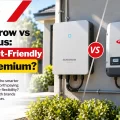
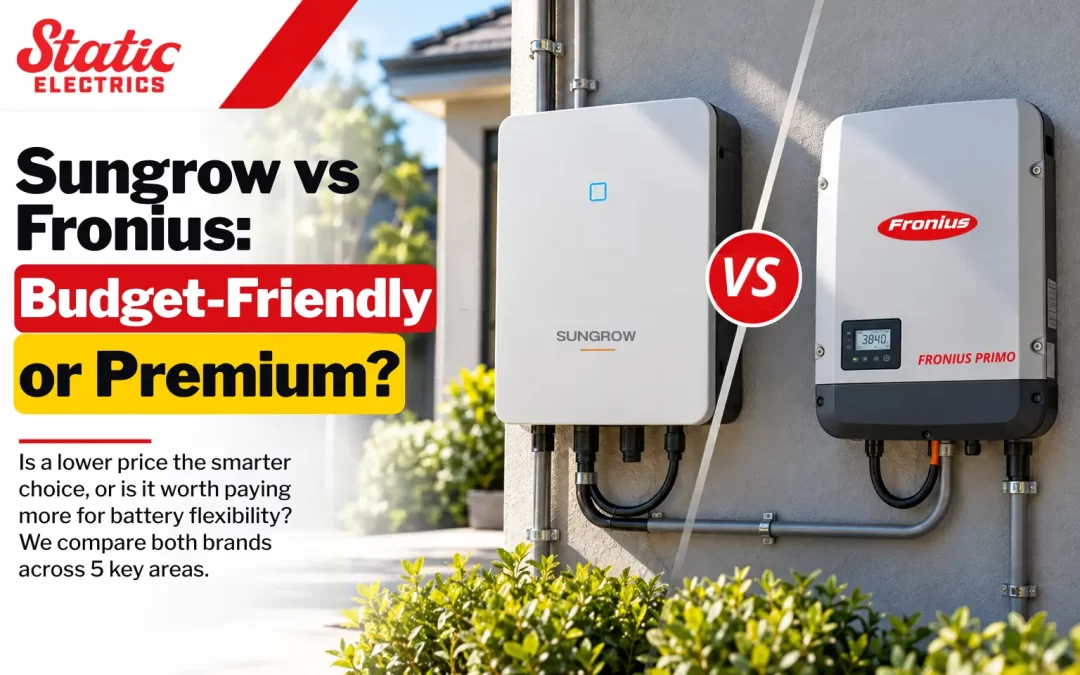
Sungrow vs Fronius is a head-to-head we’re hearing customers ask more and more across Brisbane and the Sunshine Coast, as homeowners just like you plan their solar upgrade. The honest answer? It really depends on the home.
Both are established inverter brands with strong track records in Australia – and each suits a different type of household. Neither is a bad choice, and the differences that matter are mostly practical ones.
In our exclusive Fronius vs Sungrow comparison, we’ve clearly set out where each brand fits – so you can match an inverter to your home, your budget and your plans for a battery.
Sungrow vs Fronius … At a glance
The Fronius vs Sungrow debate will end you up with a different answer depending on the specifics of your household – so here’s a quick look at each brand in brief:
Sungrow: A Chinese manufacturer known for competitively priced inverters and its own home batteries. Its SH hybrid inverters pair with Sungrow’s SBR and SBH batteries as a matched package.
Fronius: An Austrian manufacturer known for build quality and installer support. Its GEN24 Plus hybrid inverters accept batteries from other brands, including BYD Battery-Box and the newer Fronius Reserva.
What they have in common
- Both brands make single-phase and three-phase inverters
- Both offer standard string inverters for solar-only systems as well as hybrid inverters that manage a battery.
- Each has models on the Clean Energy Council approved list, which is a requirement for eligibility for solar incentives
- Each has an Australian support team.
- Both are widely installed, so most electricians are familiar with them.
How to choose between them
Your particular Sungrow inverter vs Fronius decision becomes a lot easier once you work through these 5 questions in order. Each answer will point you in one direction or the other in terms of how which brand suits your household better:
1. Set your budget
In a Sungrow vs Fronius inverter comparison, price is usually the first difference homeowners notice.
- Sungrow inverters are generally priced lower
- Fronius reflects its Austrian build and installer reputation in the higher upfront cost.
However, neither price position is a fault or a weakness. A lower price suits a tighter budget, while a higher price can reflect build and support that some households value.
So look at the whole system price – including the battery – before deciding.
2. Decide on a battery
- A Sungrow SH hybrid inverter works with Sungrow’s own SBR and SBH batteries, which makes a single matched package with less to coordinate.
- A Fronius GEN24 Plus works with BYD Battery-Box and the Fronius Reserva, which leaves room to choose a battery brand later.
It’s important to understand that both hybrid ranges are designed to take a battery, so solar can go in first and storage can follow. If you already own a battery, its brand usually decides the inverter, since the two have to be compatible.
3. Check your phase
The Fronius inverter vs Sungrow choice also depends on whether the home is single-phase or three-phase.
- Fronius offers the Primo GEN24 Plus for single-phase homes and the Symo GEN24 Plus for three-phase
- Sungrow offers the SH-RS and SH-T ranges.
Both ranges support backup power, and the Fronius GEN24 Plus offers a choice between partial backup and full backup – so confirm the backup arrangement you want before you commit to a model.
Also check that the inverter’s backup output can run everything you want to keep on during an outage.
4. Compare monitoring
Sungrow systems are monitored through the iSolarCloud app, and Fronius systems through Solar.web:
- Both show production and household use
- Both can receive software updates.
So what’s the better option? It’s really the one you find easier to read day to day. Monitoring matters most if you track your usage closely or want to shift consumption to the middle of the day.
5. Ask about support
Any Fronius vs Sungrow inverter comparison should finish with support.
TIP: Ask your installer which brand they fit most often, because familiarity speeds up commissioning and fault-finding.
Both brands have Australian support teams, and a well-supported installation matters as much as the brand name on the box. Warranty terms differ by model, so ask for them in writing and check what a claim involves.
What about the rest of the system?
The inverter is just one part of a solar system – and several other factors determine how well it performs:
- Panel quality and system size
- Roof orientation and shading
- Installation standards and commissioning
- Whether the system is sized for your household’s usage.
A well-designed system with either brand will outperform a poorly designed system with the other.
Who each brand suits
Do you feel like you’re getting a little closer to your ultimate decision? This breakdown might make it even easier.
Sungrow tends to suit households that:
- Want a matched solar and battery package
- Put upfront cost first
- Are happy to stay with one battery brand.
While Fronius tends to suit households that:
- Want freedom to choose or change battery brand
- Value European build quality and installer familiarity
- Expect to expand or rework their system over time.
So, what’s the verdict?
In honest truth, neither brand is the better inverter in every home.
Sungrow offers strong value and a simple matched solar and battery package, while Fronius offers flexibility, a premium build and a long installer track record.
The right choice is the one that matches your battery plans, your phase and your budget, and installed by someone who knows the product well.
- If your priorities are cost and a matched battery, Sungrow battery is worth a close look.
- If your priorities are flexibility and a premium build, Fronius is worth the same attention.
Get more help choosing the right inverter
Are you planning a new solar system or adding a battery to your existing setup? Static Electrics can talk you through both brands and recommend the one that suits your home.
Get in touch for upfront pricing and a 12 month workmanship warranty.
Related posts:
 Sungrow Battery Review: Should You Grab A Sungrow?
 Top 10 Fronius Error Codes: What They Mean & How To Fix Them
 Growatt Battery Review: 5 Factors Influencing Performance
 Australia’s Top 7 Solar Battery Brands Of 2025
 How Do Solar Batteries Work? A Simple Guide For Beginners
 Electrical Wiring Colours: A Clear, Safe, Aussie Guide