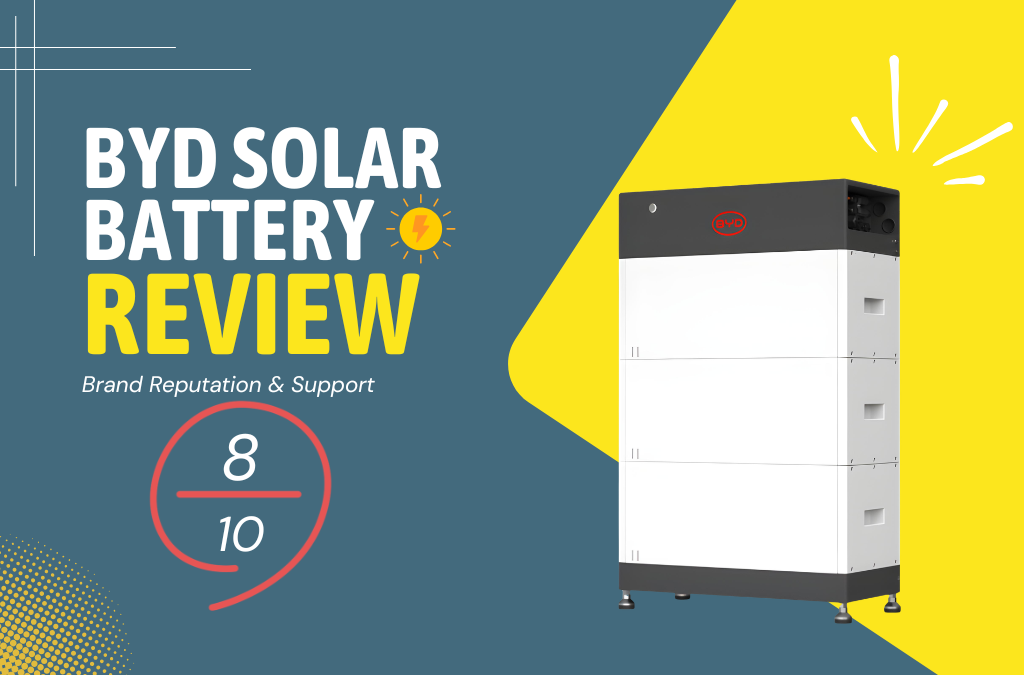
There’s a lot of marketing spin out there these days – but in our BYD solar battery review, we’re going to take a hard and honest look at how this rising giant’s Battery-Box range actually performs.
BYD is quite simply the world’s largest manufacturer of lithium iron phosphate cells, and its Battery-Box Premium HVS and HVM units have become one of the most commonly installed solar battery brands in Australian homes, bar none.
We’ve scored the areas that matter most to homeowners out of 10, then worked out where it lands overall. You’re about to find out exactly where BYD earns its reputation – and where it asks a little more of your installer to get just right.
1. Safety & battery chemistry – 9/10
BYD uses cobalt-free lithium iron phosphate (LFP) “Blade” cells, widely regarded as the safest lithium chemistry available for home storage.
LFP is far more thermally stable than older lithium chemistries, meaning a lower risk of overheating, and BYD’s cells have a strong track record of passing rigorous puncture and abuse testing without incident.
For a battery that’s going to sit in a garage or on an external wall for a decade or more, that stability is really important. Big tick here.
2. Capacity & modularity – 9/10
The Battery-Box uses a stackable, Lego-style design:
- The HVS runs from 5.1kWh up to 12.8kWh
- The HVM stretches from 8.3kWh to 22.1kWh
- Multiple towers can be paralleled for even larger systems.
What does this mean? That a household like yours can start with a modest setup and expand later as needs grow, rather than being locked into one fixed size from day one.
It’s a genuine point of difference from single-size competitors, and one that suits anyone planning to add an EV or switch off gas down the track.
3. Power output & p[erformance – 8/10
A BYD solar battery can briefly double its continuous power output, which matters an awful lot when appliances like air conditioners or pool pumps draw a heavy surge on startup.
Round-trip efficiency typically sits in the 90 to 95 percent range when paired with a quality hybrid inverter, putting it comfortably among the better performers on the market.
4. Inverter compatibility – 8/10
BYD batteries work with a wide range of hybrid inverters, including:
That makes them a really strong retrofit option for households that already have one of these installed – and there are a lot of those across Brisbane and the Sunshine Coast.
There’s no built-in inverter, so a compatible unit is required, and it won’t pair with Tesla or Enphase systems. For most Australian setups, though, that broad compatibility list covers the majority of existing installations.
5. Warranty & lifespan – 9/10
BYD backs its Battery-Box with a 10-year warranty and a strong capacity retention guarantee, supported by a rated cycle life of around 6,000 cycles.
What does that mean in practical terms? Most households can expect 10 to 15 years of solid service before any meaningful drop-off in performance, which is a genuinely long runway for a home battery, and it comfortably outlasts the loan term most people finance the system over.
6. Backup power during outages – 7/10
Backup capability during a blackout depends on pairing the battery with the right inverter and backup interface, and this is the one area where a poor installation can leave a household disappointed.
Done properly by an experienced solar battery installer, BYD systems handle outages reliably, so the outcome here comes down almost entirely to getting the setup right the first time.
7. Price & value – 8/10
A BYD solar battery price typically sits in the range of $650 to $850 per kWh of storage for the HVM series, before any rebates are applied, which is competitive against most rivals in the same capacity bracket.
After the federal battery rebate, a mid-sized system often lands in the $8,000 to $10,500 range, with payback periods commonly falling between 6 to 9 years, depending on the way your household uses power.
8. Brand reputation & support – 8/10
The brand has operated in its BYD solar battery Australia wide market since 2013, backed by a local office and a network of CEC-accredited installers across every state.
As the world’s largest LFP cell manufacturer, the company brings serious manufacturing scale to the table, and while individual installer experiences can vary, the underlying product has built a solid reputation over more than a decade locally.
THE VERDICT: 8.5/10
Add up the categories and the BYD Battery-Box lands as one of the strongest all-round options on the Australian market.
Sure, it doesn’t win every category outright – backup performance leans heavily on installation quality, and the lack of a built-in inverter means an extra component to plan for compared with fully integrated systems. But those are trade-offs that come with real upside:
- Genuine modularity
- Wide inverter compatibility for retrofits
- Pricing that consistently undercuts less flexible competitors on a per-kWh basis.
For most Australian households, this BYD solar batteries review lands very comfortably on a clear recommendation, particularly for anyone who already owns a compatible hybrid inverter or wants a system that can grow alongside their energy needs over the years ahead.
Thinking about a BYD battery for your home?
If you’re comparing options, the best BYD solar battery review Brisbane homeowners can actually do starts with a proper assessment.
We’ll look at:
- Your existing solar setup
- Your inverter
- How your household actually uses power.
The same goes for anyone chasing installation of a BYD solar battery Sunshine Coast wide, with roof orientation and daily energy habits both shaping which configuration makes sense wherever you are across the region.
Let Static Electrics walk you through sizing, compatibility and a clear, upfront quote before you commit to anything.
Related posts:
 Growatt Battery Review: 5 Factors Influencing Performance
 GoodWe Battery Review: How Do They Stack Up For Australia?
 Australia’s Top 7 Solar Battery Brands Of 2025
 How Do Solar Batteries Work? A Simple Guide For Beginners
 Sofar Battery Review: How Do They Stack Up For Australia?
 VoltX Battery Review: Is the Neovolt Worth It for QLD?