
You don’t need us to tell you this, but it hails a lot around here. In fact, at the time of writing, it was only a few days ago when the ‘loud rain’ fell on tin roofs over Eumundi and west of Coolum – and a day later in Warwick, south west of Brisbane, more hail slammed into solar panels. So it’s no surprise that we’re diving into the question: Can hail damage solar panels?
The quick answer is yes – it certainly can. But damage actually occurs a lot less than you’d probably think. Solar panels – especially the ones on the Aussie market – are built to take quite a beating, and most run-of-the-mill hailstorms come and go without leaving much of a mark at all.
That said, not even a hailstorm is run-of-the-mill. About a year ago, a supercell storm dumped hailstones measuring up to 11 centimetres across parts of Brisbane – and plenty of homeowners woke up to smashed panels. So it’s no wonder that you worry about it every time the Queensland skies turn that eerie shade of green.
So let’s pose the question again: Can hail damage my solar panels? In today’s guide, we’ll dive a little deeper – and let you know exactly what to do if a storm does leave its mark.
Just how tough are solar panels?
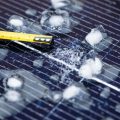
Before a panel can be approved for sale in Australia, it has to meet a minimum standard based on a strict international test (IEC 61215). As part of that test, ice balls 25 millimetres wide are fired at 11 points across the panel at about 83 kilometres an hour – which is roughly how fast a hailstone that size falls. To pass, the panel can’t show any major damage at all – and must keep producing at least 95 per cent of its original power.
Most panels are also topped with around 3.2 millimetres of tempered glass, which is several times stronger than ordinary glass. Some manufacturers go further and test their panels against much bigger hailstones as well, which is worth knowing if you live somewhere that cops a lot of storms.
When hail becomes a problem
The standard test we just described covers the hail most of us see in a typical storm – the little pellets, with the odd bigger one. Bigger hail, of course, is a slightly different story.
As they get bigger, hailstones carry far more energy. How much more? Well, compared to the 25mm stones used in testing, a golf ball sized hailstone hits that solar panel with about ten times the force. Add strong wind, which drives hail in at an angle and at a higher speed, and even the best-made panels on the planet can crack.
Older panels may also be more vulnerable than they were on the day they went up. So remember: the test standard is very much a minimum – it was never designed to cover the most extreme of storms.
What hail damage looks like
You’d think hail damage on your solar panels would be obvious – but that’s not right at all. A lot of the time, you can’t see if from the ground at all.
That damage – whether obvious or not – comes in several forms, too:
Shattered or cracked glass: The easiest damage to spot, and a panel in this state needs to be replaced.
Micro-cracks: Tiny cracks in the cells under the glass. The panel can look perfectly fine, but its output slowly drops over the following months. A solar technician can arrange specialist testing to confirm whether micro-cracks are present.
Frame & mounting damage: Bent frames or loosened mounting rails can let water in and put the whole array under stress.
Wiring damage: Hail can also damage exposed cables and connectors, which can affect the whole system.
Signs your panels may be damaged
Spotted a crack? Even if you haven’t, you can definitely watch out for a few clues that indicate damage may have occurred:
- A noticeable drop in output in your monitoring app
- Error codes or warning lights on the inverter
- Visible cracks or chips you can see from the ground
- Bits of glass on the ground near the house
- The system shutting down or switching off unexpectedly.
What to do after a hailstorm
If a big storm has just rolled through and you have a sinking feeling that your panels may have taken a beating, start at Step 1 and work your way down:
1. Stay off the roof
Can solar panels withstand hail damage? Yes, they can – but sometimes, that damage can be very difficult to spot.
We therefore think it’s a very bad idea to climb a ladder to go up there and give it a detailed look. Why? Because panels are producing dangerous voltage at the best of times – and if they’re damaged and you don’t know it, the danger could be multiplied.
On top of that, even a dry roof is extremely slippery, let alone a roof after a major storm.
So leave the climbing to a professional.
2. Check from the ground
Have a look with binoculars or from an upstairs window for cracks or bent frames – or any other obvious signs of solar panel damage.
3. Watch your monitoring app
Today’s apps are designed with helpful metrics that are pretty easy to interpret. So compare your output over the next few sunny days with what you’d normally see at that time of year.
4. Take photos
Spotted something wrong? Photograph any visible damage, along with any damage to your roof or car. It will really help with your insurance claim.
5. Contact your insurer
Let them know as soon as possible – and while you’re at it, check what your policy actually covers.
6. Book an inspection
A licensed solar electrician can check the whole system properly, including for damage you can’t see.
7. Get it fixed
Damaged solar panels can usually be replaced individually – it’s pretty unlikely that you’ll need a whole new system.
Will insurance cover it?
We just mentioned insurance, but does it actually cover solar panel damage?
In many cases, rooftop solar panels are indeed treated as part of the building – so yes, home insurance very often covers hail damage. Every policy is different, though, so it’s a good idea to check yours. A written report from a solar electrician can also help your claim go through smoothly.
As if you’re wondering if the panel manufacturer warranty might cover the damage, we’ve got bad news – in just about every case, that warranty will only cover defects in the product itself.
Choosing panels for hail-prone areas
If you’re installing a new system, or replacing smashed panels after a particularly nasty storm, it pays to think about hail from the very start.
A few tips:
- Ask your installer whether the panels have been tested against larger hail than the standard requires
- Choose a reputable brand with a solid warranty behind it
- Only get reputable installers to put them in for you, as proper, secure mounting will cope much better with our notorious wind and weather in this region.
The friendly team at Static Electrics is always happy to talk you through the options before you commit.
Need your solar panels checked?
Static Electrics repairs solar systems all across Brisbane and the Sunshine Coast. If your panels have been through a storm, our licensed electricians and solar specialists can inspect your system for hidden damage and get it producing power again.
You’ll get upfront pricing before any work begins and a 12-month workmanship warranty, extended to lifetime for Static Members. Give us a call today or book online.