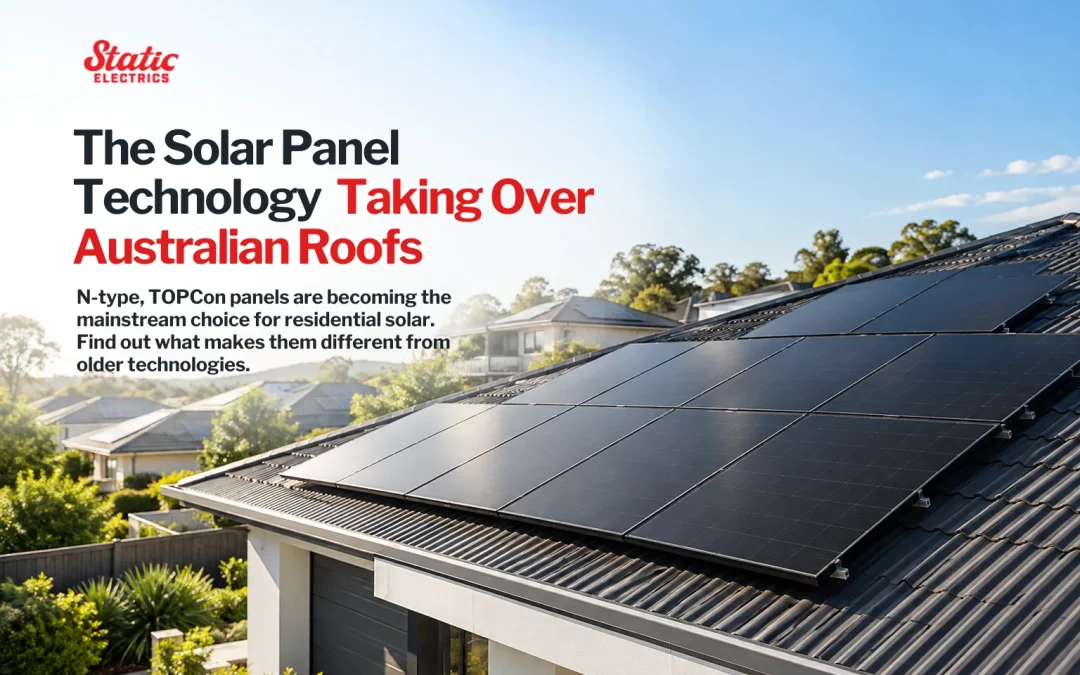
If you get three solar quotes, you’ll almost certainly get three different sets of jargon. You’ll hear terms like Mono PERC, TOPCon, N-type, back contact. It can feel like you need an actual science degree just to compare the types of solar panels on the table.
Today, we’re answering a couple of basic questions:
- Are there different types of solar panels?
- Does it matter which one ends up on your roof?
The answer to both is YES.
But the good news is that the answer to the question you’re here for is probably a lot simpler than the jargon of that quote suggests.
The panel type does affect how much power you get from your roof, and how well the system copes with a Queensland summer. And it also matters in terms of how long it will keep performing, summer after winter after summer … and so on.
In our helpful guide, we’re going to walk you through the types of solar panels in Australia right now – and what each of them does really well, and which ones suit your particular home and circumstances.
How many types of solar panels are there?
To really boil it down, there are 3 main families of solar panels.
The three families are:
- Monocrystalline
- Polycrystalline
- Thin-film.
Monocrystalline is where nearly all the action is. Why’s that? Because the types of solar panels Australia relies on today are overwhelmingly monocrystalline.
That has then split into several cell technologies – and that’s where most of the alphabet soup comes from!
The big dividing line is N-type versus P-type. But what does that mean?
It’s simply a description of the kind of silicon that’s in the cell. N-type, for the record, is the newer, more efficient option.
But what are the different types of solar panels you can actually buy today?
Here are the six you’re likely to see as you get those quotes:
The 6 types of solar panels … Explained
Just want to know the types of solar panels available in Australia? Here they are:
1. TOPCon
The current mainstream choice.
TOPCon panels use N-type monocrystalline cells, and you can expect efficiencies of around 22 to 24 per cent – which is really, really good.
They lose less output in heat than older designs and degrade more slowly – and that suits suits Queensland summers so well.
Most major manufacturers have moved their main production to TOPCon, so it’s what you’ll see quoted most often.
2. Mono PERC
PERC was the standard from around 2018 to 2023. It’s an older monocrystalline design with efficiencies of roughly 19 to 21 per cent – which is still pretty good.
You’ll still see it in the more budget-oriented systems, but it actually works extremely well. Ok, it’s gradually being replaced by TOPCon, but it can really be a sensible pick when your budget is a thing.
3. Heterojunction (HJT)
This one is a premium N-type design that sandwiches the silicon between thin layers that cut energy loss. That means efficiencies typically sit around 23 to 25 per cent – which is extraordinarily good – and it handles Queensland heat extremely well too.
Sure, it costs a little more – so it makes most sense where roof space is tight and you want every single watt you can squeeze out of it.
4. Back contact
Back contact panels move the wiring to the rear of the cell, which leaves the front clear.
What does that mean? It means slightly higher efficiency – up to around 25 per cent in the best residential models, and a clean all-black look on top.
Basically, they’re the premium end of the market – and expect the price to reflect that as well.
5. Polycrystalline
Poly panels are made from many silicon crystals melted together, which gives them a blue, speckled look.
Efficiency is a little lower – we’re talking around 15 to 17 per cent.
And they’ve largely disappeared from new installations in Australia as well. However, you’ll still spot them on older roofs, and they keep generating perfectly well. Don’t dismiss them.
6. Thin-film
Thin film panels are made by layering photovoltaic material onto a surface, and they’re lighter and sometimes flexible.
What does that mean for the efficiency? Ok, it drives it down a bit to somewhere around 10 to 13 percent in common commercial products.
They’re fairly rare on homes these days – but quite common on large commercial and utility projects, where space isn’t the constraint.
Efficiency at a glance
Let’s spell out the typical module efficiencies you can expect for each type, based on current panels sold in Australia today:
Back contact: Up to around 25 per cent
HJT: Around 23 to 25 per cent
TOPCon: Around 22 to 24 per cent
Mono PERC: Around 19 to 21 per cent
Polycrystalline: Around 15 to 17 per cent
Thin-film: Around 10 to 13 per cent.
What actually matters when you choose?
If you’re feeling a little confused, it’s important to realise that all the different types of solar panels suit different roofs, different budgets, different plans – different scenarios that play out all across our great country.
Here are the factors you should be weighing up:
Efficiency: Higher efficiency means more power from the same roof space, which matters most on smaller roofs.
Heat performance: Panels lose a little output as they heat up, and N-type designs lose slightly less than older ones.
Warranty: Look at both the product warranty and the performance warranty, which can run to 25 years or more.
Approval: Choose panels on the Clean Energy Council approved list.
Looks: Back contact panels are usually all black with no visible gridlines, which some homeowners prefer on a street-facing roof.
Price: Older designs cost less upfront, and the gap to TOPCon is smaller than it used to be.
So, which one should I choose?
Of all the different types of solar panels for home use available in Australia today, there is a safe default option each time – TOPCon.
It delivers high efficiency at a sensible price, and the types of solar panels for homes that most installers recommend today are N-type designs.
However, if your roof fairly small? In that case, HJT or back contact can definitely squeeze more power out of that limited space.
Or, if you’re on a really tight budget, quality mono PERC shouldn’t be dismissed at all, because the price is great and they still work really, really well.
Plus, if you’re thinking about adding a battery down the track, the panels you choose right now will keep working with it – for a long time.
Whichever panel you end up choosing, a really well-designed system and a proper installation matter just about as much as the type.
Need more help choosing your panels?
If you’re comparing quotes or planning a new system, Static Electrics can talk you through the options and recommend the right panels for your household – and your budget! Get in touch for upfront pricing and a 12-month workmanship warranty.